
Taking Soundings
Some thoughts about sound, space, and poetry (with extra bats)


Sailors taking soundings from Olaus Magnus (Olof Månsson), Historia de gentibus septentrionalibus, Book 2 (Antwerp, 1557)
For the past couple of weeks, I’ve been working on a journal article about George Herbert (he’ll get a lot of airtime on this Substack), in which I try to think about the relationship between sound and space in his verse. Herbert’s English devotional poems were published soon after his death in 1633 as The Temple, and one of the distinctive features of the book is the way it invites the reader to imagine the collection as a church building. The book opens with ‘The Church-Porch’ and includes several poems that direct attention to various architectural features of the church building – ‘The Altar’, ‘The Windows’, ‘The Church-Floore’, ‘and others.
As I’ve been writing, I’ve been trying to think about the ways in which Herbert invites us to think about the way sound operates in such spaces. In my line of work as the director of a choir, the link between churches and acoustics is very difficult to ignore, because it has a very immediate and practical impact on the singing of the choir. Peterhouse Chapel in Cambridge (where my choir sings most of the time, and which by a lovely coincidence was built in the same year that Herbert’s Temple was being prepared for publication by the Cambridge University Press just down the road), for instance, has a very different acoustic compared to the chapel of Herbert’s own college, Trinity. A reverberant acoustic can help amplify a voice; but too resonant, and its echoes can create a confusing babble. It’s hard for me to enter a church building and not make some kind of noise, just to see what the space sounds like.
In thinking through the relationship between sound and space in Herbert’s verse, I’ve found myself drawn to a pun which I can’t put down. It’s a pun with its own sonic logic: ‘sounding’ in the sense of not just making noises, but also measuring space with a plumbline. The two words are, etymologically speaking, two separate words with different genealogies: to ‘sound’ by making noise derives from the Latin ‘sonare’, whereas to ‘sound’ a distance with a line weighted with lead comes from a Scandinavian root (‘sund’, a strait of water). (A third possibility – ‘sound’ as in whole, complete – is also etymologically distinct, related to the German ‘gesund’, health. I’ll be writing in a few weeks’ time about Henry Vaughan’s therapeutic music, and his conception of a ‘sound mind in a sound body’.)
As I say, the more I think about the resonances of ‘sounding’, the more I’m drawn to what I find is a profound - if coincidental - logic that operates behind the like-sounding, identical chiming of these different words. One of the propositions about sound that the late Bruce Smith draws attention to in his brilliant and game-changing book The Acoustic World of Early Modern England (Chicago, 1999) is the idea that sound measures space, calibrates time, and circumscribes the horizon of sound (p.130) — a horizon of sound that Smith captures in the subtitle to the book, ‘Attending to the O-Factor’. This is the logic of echolocation and SONAR, and it is manifested in nature in the way bats inhabit and explore the dark, invisible space around them. In her inaugural address as Oxford Professor of Poetry in 2023, A.E. Stallings picked up this theme, borrowing the image of the bat poet from Randall Jarrett’s 1972 children’s book to argue for something of the bat (something batty?) about the poetic act:
Bats speak to listen. They call to elicit a response. They utter to receive. It is by sounds of things that they determine their shape and size, direction and velocity. They explore by singing and by listening. And in this way, perhaps, they do have some things in common with how poets perceive the world….A bat poet, to achieve flight, falls unknowing, headlong into the blankness, the blindness, the blackness. The bat poet lets sound do the thinking, feeling forward by rhymes and other correspondences, etymologies, perhaps even by stanzas.[1]
I like this idea of ‘letting sound do the thinking’, that sense of sonic correspondences (just like that sonic identity of the pun, or the close sounded proximity of rhyme) as part of the way the poetic craft ‘feels forward’ towards some kind of understanding.
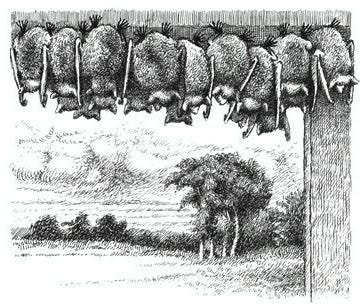
Image by Maurice Sendak from The Bat Poet by Randall Jarrell (New York, 1972)
The pun is there in early modern literature: John Mason’s well-known hymn ‘How shall I sing that majesty’ combines the idea of singing and bearing a part with the celestial choir with a conception of God’s unfathomable nature:
How shall I sing that majesty
which angels do admire?
Let dust in dust and silence lie;
sing, sing, ye heavenly choir.
Thousands of thousands stand around
thy throne, O God most high;
ten thousand times ten thousand sound
thy praise; but who am I?…
How great a being, Lord, is thine,
which doth all beings keep!
Thy knowledge is the only line
to sound so vast a deep.
Thou art a sea without a shore,
a sun without a sphere;
thy time is now and evermore,
thy place is everywhere.
Herbert himself uses the word ‘sounding’ twice in his verse. ‘The Agonie’ opens with the following stanza:
          Philosophers have measured mountains,
Fathomed the depths of seas, of states, and kings,
Walked with a staff to heav’n, and traced fountains:
          But there are two vast spacious things,
The which to measure it doth more behove:
Yet few there are that sound them; Sin and Love.
Here, I think, Herbert’s mind is mainly focused on the spatial possibilities of sounding: contrasting the ambitious achievements of the natural philosophers in measuring mountains and fathoming seas with the very different kind of ‘sounding’. This sounding requires a different kind of measuring, and in the two succeeding stanzas of the poem, Herbert invites us to traverse space and historical time in the imagination, to return to Mount Olivet not to measure its height, but to see Sin and Love ‘sounded’ by Christ’s unfathomable sacrifice on the cross. There’s something akin, I think, to Mason’s (later) musings here about the boundlessness of God in the ‘vast spacious things’ that few can sound in Herbert’s verse: is Mason sounding out Herbert’s lines, perhaps?
In his second use of the term, in the sonnet (itself literally a ‘little sounding’) ‘Prayer (I)’, I think Herbert pushes us gently towards the homophonic chiming I’ve been talking about. Here, he memorably describes prayer as ‘The Christian plummet sounding heav’n and earth’:
Prayer the Churches banquet, Angels age,
Gods breath in man returning to his birth,
The soul in paraphrase, heart in pilgrimage,
The Christian plummet sounding heav’n and earth.
Engine against th’Almighty, sinners’ tower,
Reversed thunder, Christ side-piercing spear,
The six days world-transposing in an hour,
A kind of tune, which all things hear and fear;
Softness, and peace, and joy, and love, and bliss,
Exalted Manna, gladness of the best,
Heaven in ordinarie, man well dressed,
The milky way, the bird of Paradise,
Church bels beyond the starres heard, the soul’s blood,
The land of spices, something understood.
This is a poem concerned with acts of communication, between humanity and God, which frequently draws on a sonic register: most explicitly, we hear ‘A kind of tune, which all things hear and fear’, as well as the pealing of ‘Church bels beyond the starres heard’. Is it reasonable also to hear a kind of echo between the pealing of these bells and the pealing of the ‘Reversed thunder’ earlier in the poem? What would ‘Reversed thunder’ sound like? And what is the relationship between this strangely inverted meteorological rumbling and the precipitously falling plummet of line 4? All of this contained within the perfectly ‘sound’, formal sonnet structure.
Perhaps these seem like only faint reverberations to you: but I think—just as the sonic correspondence of ‘sounding’ has its logic—this is a poem that invites us to hear such sympathetic resonances, to work out how these various images relate and correspond to each other. It invites, for me at least, this kind of speculation. It’s the reader’s task to make sense of this tapestry of image, like the bat discovering something about their surroundings. The knowledge may only be partial, but that’s ok: after all, this is the poem that famously ends with—what? the partiality? satisfaction? relief? frustration?—of ‘something understood’. This is the bat poet, feeling forward in the dark, towards some kind of understanding.
There’s much more to be said about this idea. I’m still feeling my own way forward with these ideas, and I want to think more in more detail about the sonic architecture of Herbert’s Temple in particular, but also more widely about listening as an ecological, environmental act. More anon.
References
[1] A.E. Stallings, ‘The Bat Poet: Poetry as Echolocation’, 20 November 2023 <podcasts.ox.ac.uk/bat-poet-poetry-echolocation>. I’m grateful to one of my students at Peterhouse for pointing me in the direction of this lecture
I find your approach fascinating. I’ve long thought literature lacks a framework? vocabulary? Even a form of notation to think about, and fully appreciate sound. I look forward to your work.
Brilliant Simon. I'm working on the Judith Weir setting of 'Prayer' at the moment and I think she captures that bat-like 'sounding' with the two soloists feeling their way through the piece...